
Practical considerations for reliable use, human oversight, and ROI measurement.
The use of AI is spreading faster than proven business results
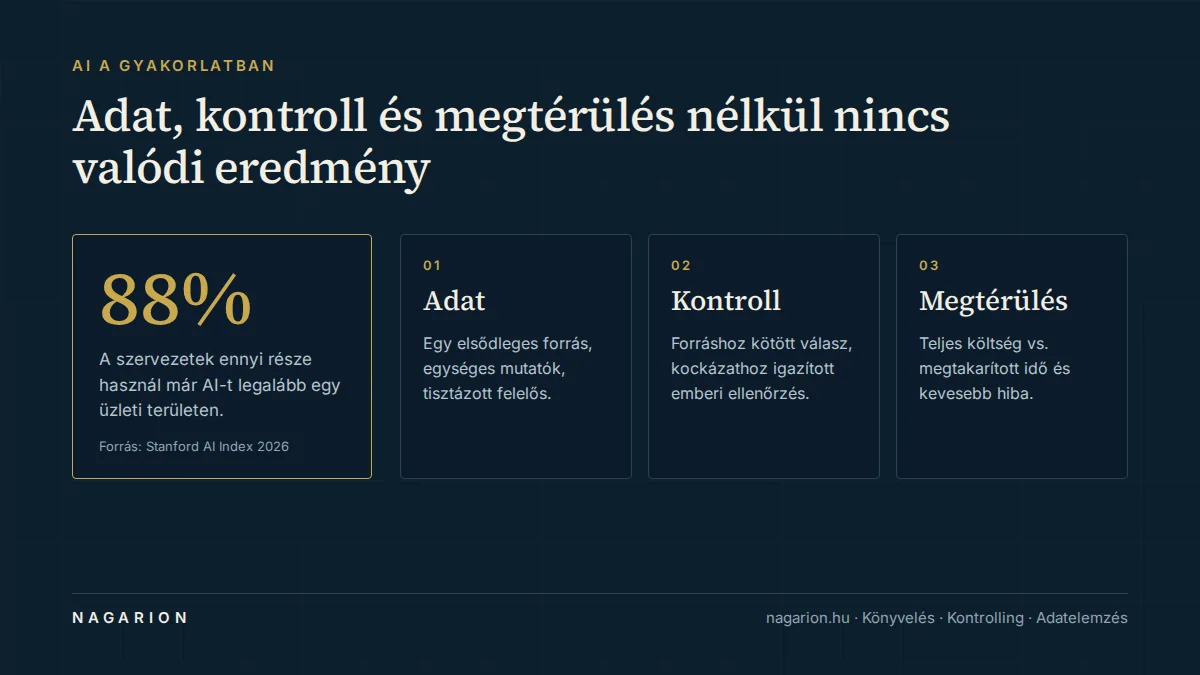
Generative AI has found its way into office work in just a few years. According to Stanford's 2026 AI Index report, 88 percent of surveyed organizations used AI in at least one business area, and 79 percent also regularly employed generative AI. At the same time, the use of more autonomous AI agents remained in the single-digit percentage range in most areas.
Rapid adoption is not the same as a guaranteed return on investment. An employee can start using a text-based AI tool in just a few minutes, whereas enterprise deployment requires data connections, access rules, testing, training, and ongoing monitoring. There can be a significant difference between a flashy demonstration and a sustainably functioning workflow.
Therefore, the first question is not which AI tool to buy. First, we need to determine which task is too slow, expensive, or error-prone, and what kind of change we expect from the improvement.
A good result starts with the workflow
An AI system is not an independent business solution. It is integrated into an existing process that has input data, responsible parties, checkpoints, and expected outcomes. If these are not clarified, AI will only reproduce uncertainty faster.
Let's take a simple example. A business wants to automate the classification of incoming invoices. For this, it is not enough for the model to recognize the text of the invoice. It needs to know what cost categories the company uses, how items spanning multiple periods are handled, in which cases human approval is mandatory, and where the decision is recorded.
If the process is not even standardized now, AI will not decide on its own which previous practice was correct. Therefore, exceptions, responsibilities, and acceptance criteria must be sorted out before implementation.
Data is the first checkpoint
The quality of an AI's response is heavily determined by the data it receives and the context in which that data can be interpreted. Incomplete data produces an incomplete picture. Contradictory data leads to uncertain conclusions. In the case of poorly named or inconsistently calculated metrics, the system can give a bad business answer even with precise calculations.
A reliable data background does not start with complicated policies. First, a few basic questions need to be answered.
- Which system is considered the primary data source?
- Who is responsible for the accuracy and correction of the data?
- Does everyone interpret the indicators used in the same way?
- What data can be sent to an external AI service?
- How long do we retain the inputs and generated results?
NIST's generative AI risk management guidance places special emphasis on examining data provenance, suitability, accuracy, and representativeness. This is not just an enterprise-level expectation. For an SME, it is just as important to know which file, which time period, and what calculation rules were used to generate a financial summary.
A convincing answer can still be wrong
A specific risk of generative AI is its ability to confidently articulate erroneous content. NIST refers to this as confabulation: the system produces a response that is false, fabricated, contradicts the input, or contradicts its own previous statements.
In a business environment, this is dangerous because a linguistically well-structured response easily looks like a professional conclusion. An inaccurate tax explanation, a flawed contract summary, or a misinterpreted financial discrepancy can be convincing even if its basis cannot be verified.
Good AI usage is therefore source-bound. The system should, whenever possible, work from specified corporate documents, the source used must be made visible next to the response, and results with significant consequences must be approved by an expert.
The task of human control
Human control does not mean that someone quickly skims through the finished text. The reviewer must know the task, have access to the original data, and know what kind of error to look for. If the same person who prepared the input is reviewing it, special attention should be paid to re-examining their own assumptions.
The strength of the control must be tailored to the risk. An internal list of ideas requires less control than a financial analysis sent to a client. In the case of results supporting tax, legal, employment, or high-value financial decisions, AI cannot replace the appropriate professional.
The European Union's AI Act regulation also establishes obligations based on risk levels. For high-risk systems, key expectations include data quality, logging, documentation, human oversight, accuracy, and cybersecurity. Not all enterprise AI usage falls into this category, but these aspects provide a good basis for control even for smaller developments.
Good AI usage is verifiable
Corporate AI becomes useful when it delivers measurable results within a specific workflow. This requires reliable data, clear accountability, appropriate human control, and regular measurement.
When examining the return on investment, it is not enough to consider just the subscription fee of the AI tool. Data preparation, implementation, system integration, monitoring, employee training, and ongoing operation also incur costs. These must be weighed against the time saved, the reduction in errors, and demonstrable business results.
Technology changes rapidly, so implementation is not a one-time project. The model, source data, user habits, and business environment may all change. What is accurate today must be checked later as well. And what does not bring verifiable improvement is not worth maintaining just because it runs on AI.
Related articles
- What does a good leadership report show? – how to create a financial picture that can be used from the accounting data.
- Where bookkeeping ends and financial consulting begins – why accurate accounting alone is not enough for management decisions.
More articles on Data analysis in this area.
Next step
If you want to assess in which financial or administrative process it might make sense to apply AI, let's first look at the current operations and the measurable baseline values. Request a consultation from the Nagarion team.
Sources
European Commission: AI Act – Regulatory Framework for Artificial Intelligence
Stanford Institute for Human-Centered AI: The 2026 AI Index Report
National Institute of Standards and Technology Artificial Intelligence Risk Management Framework – Generative Artificial Intelligence Profile